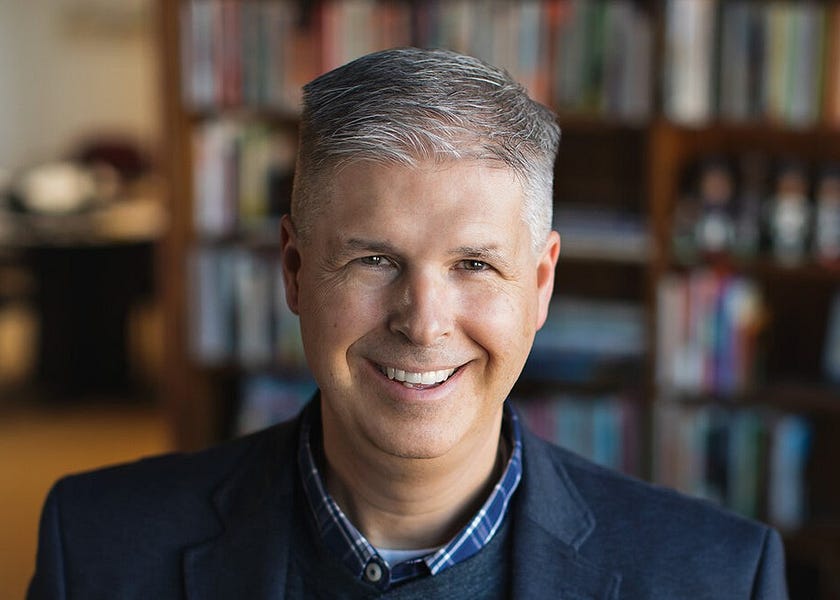
Volts podcast: Charles Marohn on unsustainable suburbs
In this episode, Charles Marohn of Strong Towns discusses why urban planning too often creates money-sucking suburbs, what it might look like to build healthy communities, and why there are so many barriers to doing so.
(PDF transcript)
(Active transcript)
Text transcript:
David Roberts
Charles Marohn — “Chuck” to his friends — grew up in a small town in Minnesota and later became an urban planner and traffic engineer in the state. After a few years, he began noticing that the projects he was building were hurting the towns he was putting them in — subtracting more tax value than they added, forcing everyone into cars, breaking apart communities and saddling them with unsustainable long-term liabilities.
He began recording his observations on a blog called Strong Towns. It quickly caught on, and over the years, Strong Towns has grown into a full-fledged nonprofit with an educational curriculum, an awards program, and a rich network of local chapters working to improve the towns where they are located.
Marohn has since written several books, most recently 2021’s Confessions of a Recovering Engineer and 2019’s Strong Towns. Intellectually, he sits somewhat orthogonally to most of the contemporary urbanist community. He’s an avowed conservative and opposes many of the state and federal solutions to the housing crisis favored by today’s YIMBYs.
But there is arguably no one alive in America who has done more to get people thinking about what makes for a healthy community and how the US can begin to repair its abysmal late-20th-century land-use choices. I was excited to talk to Marohn about why suburbs are money-losers, the right way to think about NIMBYs and local control, and why the city planning profession is so resistant to reform.
Okey-doke, without any further ado, Chuck Marohn of Strong Towns. Welcome to Volts. Thanks for coming.
Charles Marohn
Hey, thanks for having me.
David Roberts
This is really cool. I've been sort of a follower of Strong Towns for many, many years. It's great to finally get you on here. I wish we could be talking under more pleasant circumstances.
Charles Marohn
Oh yeah. You got to always have some joy and optimism to things.
David Roberts
I'm trying. Before we get into any of that stuff, I am sure this is something you've talked about a million times, but I still don't know that it's sunk into the general public. So let's just summarize real quick right off the bat, the core of the Strong Town's critique of suburbs, the sort of Ponzi scheme critique. Because I think still to this day, it probably comes as a surprise to most average Americans, just the idea that suburbs don't pay for themselves, but I just don't think most people know it. So let's just review that real quick.
Charles Marohn
It's astounding though because we've come a long way, because now I see when people bring up what is kind of like an ignorant statement of like, "I pay my taxes, this stuff is paying ..." people are like, "Whoa, hang on, let me show you something." So when I was a young engineer and planner, I have a civil engineering degree, I have a planning degree, I was building all this stuff to make cities really successful. I was putting in roads and streets and pipes and building Walmart parking lots and Arby's drive throughs and ...
David Roberts
Every architect's dream as a child.
Charles Marohn
Oh, yeah, no, this was great stuff. And I believed in my heart that I was making the city that I live in, the city that I grew up in, wealthier and more prosperous. But over and over and over again, I would be exposed to these insane projects. These projects that if you're an engineer, you kind of work in a silo of design. If you're a planner, you kind