Taking carbon out of the air and putting it into concrete
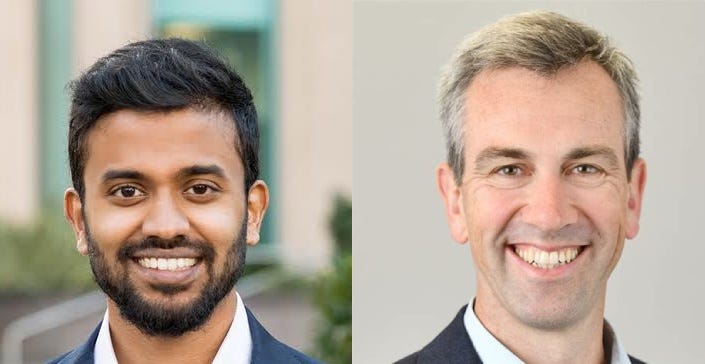
Under a new partnership, Heirloom Carbon Technologies captures carbon dioxide from the air, then passes it to CarbonCure Technologies, which permanently sequesters it in concrete. In this episode, CEOs Shashank Samala of Heirloom and Robert Niven of CarbonCure give the lowdown on this pioneering carbon removal project.
(PDF transcript)
(Active transcript)
Text transcript:
David Roberts
Last month saw the announcement of a pioneering project: a company called Heirloom Carbon Technologies will capture carbon dioxide from the ambient air and then hand it off to a company called CarbonCure Technologies, which will inject the CO2 into concrete made by a company called Central Concrete. It will mark the first time ever that carbon from the air is permanently sequestered in concrete.
Heirloom, with runs the US’s only operating direct air capture (DAC) facility, does not use the familiar capture technique that involves giant fans. Instead, it binds carbon to exposed rock and then cooks it out using electric kilns — and then binds more carbon to the rock, in a circular process. It claims the capture is cheaper and more efficient than previous methods.
CarbonCure injects the CO2 into a concrete mixer, where it mineralizes, becoming permanently captured even if the building using the concrete is demolished. In the process, it strengthens the mix, requiring less cement and cutting costs.
Direct air capture (DAC) has faced a great deal of skepticism, and concrete has the reputation as one of the worst carbon offenders, so this project — one of the first that can fairly be called carbon removal — could go a long way toward convincing investors that the former can help the latter change its ways, with a technology that is, at least some day, commercializable.
I talked with Heirloom CEO Shashank Samala and CarbonCure CEO Robert Niven about their respective processes, how they work together, and what the project says about the future of carbon removal.
All right, Shashank Samala, CEO of Heirloom Carbon Technologies, and Robert Niven, CEO of CarbonCure. Welcome to Volts. Thank you guys for coming.
Robert Niven
Thanks very much for having us.
David Roberts
This is really a nifty project you guys are working on together. It's two separate pieces that normally I would probably do a pod on each. So we're going to have to, or at least I'm going to have to be less wordy than normal to squeeze it all in in 1 hour. I want to talk about both halves of it. So let's start with Shashank. The first half of this process is Heirloom’s process of removing carbon from the air. Can you just explain quickly how that process works, what it looks like?
Shashank Samala
Sure. So, Heirloom, if you're not aware of who we are, our goal is to basically remove a billion tons of CO2 from the atmosphere annually by 2035. And our whole goal is to help reverse climate change. And the way we do that is through a process called limestone looping. Essentially what that means is we use a rock that is very abundant in nature, limestone, that has a natural propensity to pull carbon from the air. What we do is we basically give superpowers to limestone to pull a lot more carbon than it otherwise would naturally.
So how it works is we start with limestone, we put that into a kiln, we heat it up, and we pull out the CO2 that's already sequestered in the limestone, which makes the leftover lime highly thirsty for CO2. So we take advantage of that natural