Outlasting Noam Shazeer, crowdsourcing Chai AI with >1.4m DAU, and becoming the "Western DeepSeek" — with William Beauchamp, Chai Research
One last Gold sponsor slotis available for the AI Engineer Summit in NYC. Our last round of invites is going out soon - apply here - If you are building AI agents or AI eng teams, this will be the single highest-signal conference of the year for you!
While the world melts down over DeepSeek, few are talking about the OTHER notable group of former hedge fund traders who pivoted into AI and built a remarkably profitable consumer AI business with a tiny team with incredibly cracked engineering team — Chai Research. In short order they have:
* Started a Chat AI company well before Noam Shazeer started Character AI, and outlasted his departure.
* Crossed 1m DAU in 2.5 years - William updates us on the pod that they’ve hit 1.4m DAU now, another +40% from a few months ago. Revenue crossed >$22m.
* Launched the Chaiverse model crowdsourcing platform - taking 3-4 week A/B testing cycles down to 3-4 hours, and deploying >100 models a week.
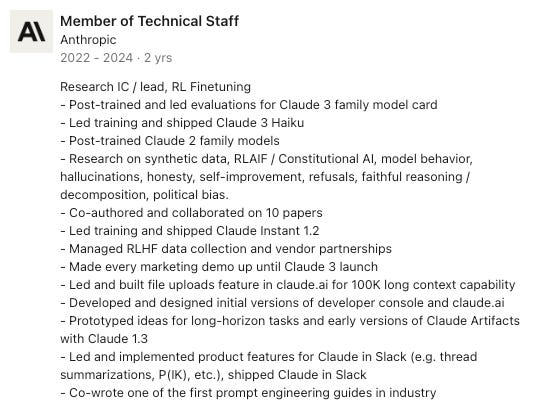
While they’re not paying million dollar salaries, you can tell they’re doing pretty well for an 11 person startup:
The Chai Recipe: Building infra for rapid evals
Remember how the central thesis of LMarena (formerly LMsys) is that the only comprehensive way to evaluate LLMs is to let users try them out and pick winners?
At the core of Chai is a mobile app that looks like Character AI, but is actually the largest LLM A/B testing arena in the world, specialized on retaining chat users for Chai’s usecases (therapy, assistant, roleplay, etc). It’s basically what LMArena would be if taken very, very seriously at one company (with $1m in prizes to boot):
Chai publishes occasional research on how they think about this, including talks at their Palo Alto office:
William expands upon this in today’s podcast (34 mins in):
Fundamentally, the way I would describe it is when you're building anything in life, you need to be able to evaluate it. And through evaluation, you can iterate, we can look at benchmarks, and we can say the issues with benchmarks and why they may not generalize as well as one would hope in the challenges of working with them. But something that works incredibly well is getting feedback from humans. And so we built this thing where anyone can submit a model to our developer backend, and it gets put in front of 5000 users, and the users can rate it.
And we can then have a really accurate ranking of like which model, or users finding more engaging or more entertaining. And it gets, you know, it's at this point now, where every day we're able to, I mean, we evaluate between 20 and 50 models, LLMs, every single day, right. So even though we've got only got a team of, say, five AI researchers, they're able to iterate a huge quantity of LLMs, right. So our team ships, let's just say minimum 100 LLMs a week is what we're able to iterate through. Now, before that moment in time, we might iterate through three a week, we might, you know, there was a time when even doing like five a month was a challenge, right? By being able to change the feedback loops to the point where it's not, let's launch these three models, let's do an A-B test, let's assign, let's do different cohorts, let's wait 30 days to see what the day 30 retention is, which is the kind of the, if you're doing an app, that's like A-B testing 101 would be, do a 30-day retention test, assign different treatments to different cohorts and come back in 30 days. So that's insanely slow. That's just, it's too slow. And so we were able to get that 30-day feedback loop all the way down to something like three hours.
In [Crowdsourcing the leap to Ten Trillion-Parameter AGI](https://www.blog.chai-research.com/post/crowdsourcing-the-le