The RLVR Revolution — with Nathan Lambert (AI2, Interconnects.ai)
We first had Nathan on to give us his RLHF deep dive when he was joining AI2, and now he’s back to help us catch up on the evolution to RLVR (Reinforcement Learning with Verifiable Rewards), first proposed in his Tulu 3 paper. While RLHF remains foundational, RLVR has emerged as a powerful approach for training models on tasks with clear success criteria and using verifiable, objective functions as reward signals—particularly useful in domains like math, code correctness, and instruction-following. Instead of relying solely on subjective human feedback, RLVR leverages deterministic signals to guide optimization, making it more scalable and potentially more reliable across many domains. However, he notes that RLVR is still rapidly evolving, especially regarding how it handles tool use and multi-step reasoning.
We also discussed the Tulu model series, a family of instruction-tuned open models developed at AI2. Tulu is designed to be a reproducible, state-of-the-art post-training recipe for the open community. Unlike frontier labs like OpenAI or Anthropic, which rely on vast and often proprietary datasets, Tulu aims to distill and democratize best practices for instruction and preference tuning. We are impressed with how small eval suites, careful task selection, and transparent methodology can rival even the best proprietary models on specific benchmarks.
One of the most fascinating threads is the challenge of incorporating tool use into RL frameworks. Lambert highlights that while you can prompt a model to use tools like search or code execution, getting the model to reliably learn when and how to use them through RL is much harder. This is compounded by the difficulty of designing reward functions that avoid overoptimization—where models learn to “game” the reward signal rather than solve the underlying task. This is particularly problematic in code generation, where models might reward hack unit tests by inserting pass statements instead of correct logic. As models become more agentic and are expected to plan, retrieve, and act across multiple tools, reward design becomes a critical bottleneck.
Other topics covered:
- The evolution from RLHF (Reinforcement Learning from Human Feedback) to RLVR (Reinforcement Learning from Verifiable Rewards)- The goals and technical architecture of the Tulu models, including the motivation to open-source post-training recipes- Challenges of tool use in RL: verifiability, reward design, and scaling across domains- Evaluation frameworks and the role of platforms like Chatbot Arena and emerging “arena”-style benchmarks- The strategic tension between hybrid reasoning models and unified reasoning models at the frontier- Planning, abstraction, and calibration in reasoning agents and why these concepts matter- The future of open-source AI models, including DeepSeek, OLMo, and the potential for an “American DeepSeek”- The importance of model personality, character tuning, and the model spec paradigm- Overoptimization in RL settings and how it manifests in different domains (control tasks, code, math)- Industry trends in inference-time scaling and model parallelism
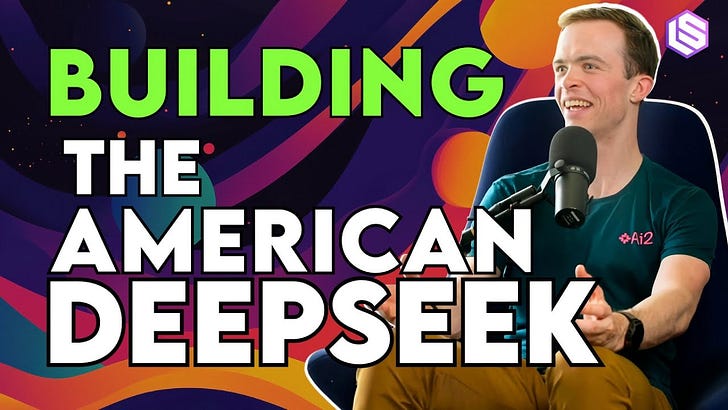
Finally, the episode closes with a vision for the future of open-source AI. Nathan has now written up his ambition to build an “American DeepSeek”—a fully open, end-to-end reasoning-capable model with transparent training data, tools, and infrastructure. He emphasizes that open-source AI is not just about weights; it’s about releasing recipes, evaluations, and methods that lower the barrier for everyone to build and understand cutting-edge systems.
Full Video Episode
Timestamps
00:00 Welcome and Guest Introduction
01:18 Tulu, OVR, and the RLVR Journey
03:40 Industry Approaches to Post-Training and Preference Data
06:08 Understanding RLVR and Its Impact
06:18 Agents, Tool Use, and Training Environments
10:34 Open Data, Human Feedback, and Benchmarking
12:44 Chatbot Arena, Sycophancy, and Evaluation Platforms
15:42 RLHF vs RLVR: Books, Algori