Commoditizing the Petaflop — with George Hotz of the tiny corp
We are now launching our dedicated new YouTubeand Twitter! Any help in amplifying our podcast would be greatly appreciated, and of course, tell your friends!
Notable followon discussions collected on Twitter, Reddit, Reddit, Reddit, HN, and HN. Please don’t obsess too much over the GPT4 discussion as it is mostly rumor; we spent much more time on tinybox/tinygrad on which George is the foremost authority!
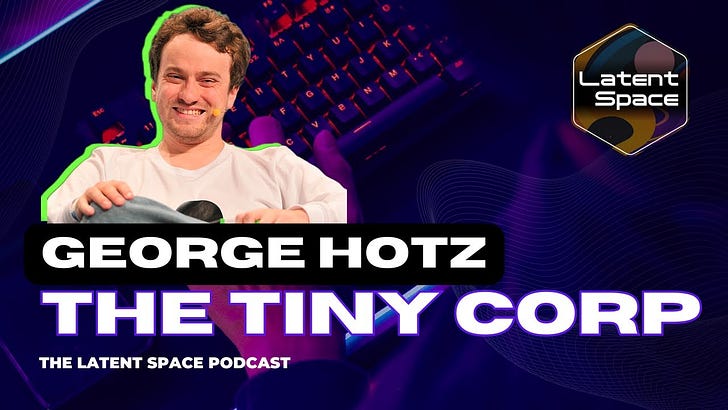
We are excited to share the world’s first interview with George Hotz on the tiny corp!
If you don’t know George, he was the first person to unlock the iPhone, jailbreak the PS3, went on to start Comma.ai, and briefly “interned” at the Elon Musk-run Twitter.
Tinycorp is the company behind the deep learning framework tinygrad, as well as the recently announced tinybox, a new $15,000 “luxury AI computer” aimed at local model training and inference, aka your “personal compute cluster”:
* 738 FP16 TFLOPS
* 144 GB GPU RAM
* 5.76 TB/s RAM bandwidth
* 30 GB/s model load bandwidth (big llama loads in around 4 seconds)
* AMD EPYC CPU
* 1600W (one 120V outlet)
* Runs 65B FP16 LLaMA out of the box (using tinygrad, subject to software development risks)
(In the episode, we also talked about the future of the tinybox as the intelligence center of every home that will help run models, at-home robots, and more. Make sure to check the timestamps 👀 )
The tiny corp manifesto
There are three main theses to tinycorp:
* If XLA/PrimTorch are CISC, tinygrad is RISC: CISC (Complex Instruction Set Computing) are more complex instruction sets where a single instruction can execute many low-level operations. RISC (Reduced Instruction Set Computing) are smaller, and only let you execute a single low-level operation per instruction, leading to faster and more efficient instruction execution. If you’ve used the Apple Silicon M1/M2, AMD Ryzen, or Raspberry Pi, you’ve used a RISC computer.
* If you can’t write a fast ML framework for GPU, you can’t write one for your own chip: there are many “AI chips” companies out there, and they all started from taping the chip. Some of them like Cerebras are still building, while others like Graphcore seem to be struggling. But building chips with higher TFLOPS isn’t enough: “There’s a great chip already on the market. For $999, you get a 123 TFLOP card with 24 GB of 960 GB/s RAM. This is the best FLOPS per dollar today, and yet…nobody in ML uses it.”, referring to the AMD RX 7900 XTX. NVIDIA’s lead is not only thanks to high-performing cards, but also thanks to a great developer platform in CUDA. Starting with the chip development rather than the dev toolkit is much more cost-intensive, so tinycorp is starting by writing a framework for off-the-shelf hardware rather than taping their own chip.
* Turing completeness considered harmful: Once you call in to Turing complete kernels, you can no longer reason about their behavior. Since they have